

03 Jul 2026

Deepfakes, Voice Cloning and PDPL Compliance: Why Biometric and Access Control Systems Need an Upgrade in 2026
 by Admin
 0 Comment
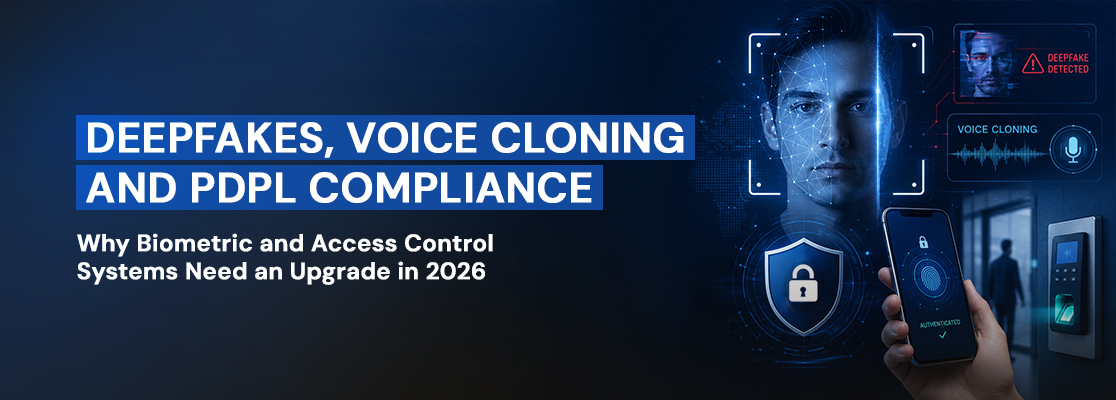
Table of Contents
- Deepfakes and Voice Cloning: The Emerging Threat to Business Security
- Why Traditional Access Control Systems Are No Longer Enough in 2026
- What is Biometric Access Control and Why It Matters
- Biometric Data and UAE PDPL: What Businesses Must Review
- Beyond Biometrics: IT Systems That Can Impact PDPL Compliance
- UAE Business Security and PDPL Compliance 2026 Checklist
GS IT works with businesses across the UAE, and one thing we hear consistently is that security has become harder to get right than it used to be. A few years ago, a strong password policy and a swipe card system were enough. Today, that same setup can be bypassed in minutes using tools that were barely imaginable back then. Deepfake voice cloning and AI generated impersonation have quietly moved from being a curiosity to a genuine business risk, and a lot of companies are still catching up.
This blog breaks down what these threats look like in practice, why your current access control setup might not be equipped to handle them, and the steps UAE businesses should be considering as they head into the second half of 2026. At the same time, the pressure of meeting the 2026 UAE Personal Data Protection Law (PDPL) compliance requirements is adding a second layer of urgency for businesses across the Emirates, with the January 2027 compliance deadline fast approaching. Since biometric data lies at the heart of PDPL compliance, organizations must make it a key part of their compliance strategy.
Deepfakes and Voice Cloning: The Emerging Threat to Business Security
Deepfakes are AI-generated videos or images that convincingly replace one person's face or voice with another. Voice cloning takes this step further by replicating someone's vocal patterns from just a short audio sample. These synthetic audio threats are growing in volume and sophistication, and deepfake voice cloning detection has become a serious technical challenge for security teams.
For businesses, this creates a new category of risk. Audio deepfakes are being used to impersonate executives, while voice authentication vulnerabilities and synthetic identity fraud are enabling attackers to bypass verification processes and deceive employees into sharing sensitive information or authorizing fraudulent transactions.
Social engineering attacks are becoming more targeted, with attackers using AI-generated voices to impersonate CFOs and other executives to trick employees into sharing credentials or authorizing payments. At the same time, biometric spoofing, including fake faces, replayed audio, and 3D masks, has become a real threat, making advanced spoof detection essential for secure access control.
Why Traditional Access Control Systems Are No Longer Enough in 2026
For most of the past decade, access control has relied on three things: something you know (a PIN or password), something you have (a card or fob), or a combination of both. While these methods are familiar, easy to deploy, and cost-effective, they have significant security gaps. Access cards can be lost, shared, or cloned, while PINs and passwords are often weak, reused, or easily compromised, making credential-based security increasingly vulnerable.
As insider threats and AI-driven impersonation become more sophisticated, relying solely on credentials is no longer enough. Employees or contractors with active access can misuse credentials before IT detects suspicious activity. Biometric risk management addresses this challenge by verifying a person's identity rather than simply validating a card, key, or PIN, providing stronger protection for sensitive data and critical business assets.
What is Biometric Access Control and Why It Matters
Biometric access control systems use physical characteristics that are unique to everyone to verify identity. The most widely deployed types are fingerprint scanners and facial recognition cameras, though iris scanning and hand geometry are also used in higher-security environments. For many UAE businesses, 2026 is the right moment to consider an AI biometric security upgrade, replacing older credential-based setups with systems that actively verify the person rather than just the card or code they carry.
Modern biometric systems use deepfake liveness detection to identify spoofing attempts such as 3D masks, printed photos, replayed videos, and AI-generated media. Combined with voice spoofing protection and deepfake access control, these technologies provide stronger identity verification than traditional access methods. For maximum security, organizations are increasingly adopting zero trust biometrics as part of a broader zero trust architecture, where every user and device is continuously verified before access is granted.
GS IT's biometric attendance system in Dubai supports facial recognition, fingerprint scanning, iris recognition, and more, with seamless integration into payroll and HR systems across multi-location deployments.
Biometric Data and UAE PDPL: What Businesses Must Review
The UAE PDPL classifies biometric data as sensitive personal data, making PDPL data privacy a critical priority for businesses. To comply with biometric data privacy regulations, organizations must securely manage biometric data, maintain consent records, and control data access and retention.
For organizations with international or regional operations, compliance extends beyond the UAE. If a UAE business processes the personal data of European Union (EU) residents or operates internationally, it may also need to comply with the GDPR (General Data Protection Regulation). Likewise, businesses operating in Saudi Arabia must comply with the Saudi PDPL, which is enforced by the Saudi Data & AI Authority (SDAIA). Ensuring compliance with these regulations is essential for organizations handling personal data across multiple jurisdictions.
Key considerations under the UAE PDPL include:
- Consent and purpose limitation: Collect biometric data only for a clearly defined purpose and ensure individuals understand how it will be used.
- Secure storage: Protect biometric templates with encryption and restrict access to authorized personnel.
- Data minimization: Collect only biometric data necessary and avoid storing raw biometric images when a secure template is enough.
- Retention limits: Define retention periods and securely delete biometric data when it is no longer required.
- Audit readiness: Maintain documented policies, consent records, access logs, and regular compliance reviews.
- Non-compliance risks: Failure to comply can result in regulatory penalties, legal consequences, and reputational damage following a data breach.
Beyond Biometrics: IT Systems That Can Impact PDPL Compliance
Biometric access control is one piece of a larger compliance picture. Several other IT systems in your business may also fall under PDPL scrutiny, and it is worth reviewing them alongside your biometric setup.
CCTV surveillance systems
Video footage of identifiable individuals is personal data under the PDPL. If your CCTV system retains footage for longer than necessary, lacks appropriate access controls, or is connected to third-party platforms without proper agreements in place, it is an area of potential exposure.
IP phone and call recording systems
Call recordings capture personal data, sometimes sensitive data depending on the conversation. Businesses using IP phone systems with call logging or recording features need to review their retention policies, consent mechanisms, and storage security.
Microsoft 365 and cloud platforms
Your Microsoft 365 environment holds a large volume of personal data in emails, shared drives, Teams conversations, and forms. Conditional access policies, data loss prevention rules, and information protection labels are tools that should be configured rather than left at default settings.
UAE Business Security and PDPL Compliance 2026 Checklist
With the January 2027 compliance deadline approaching, here are the practical steps to work through before the end of 2026:
- Review whether your access control system verifies identity, not just cards, PINs, or credentials.
- Secure biometric data with encryption, restricted access, and clearly defined retention policies.
- Obtain and document consent before collecting or processing biometric information.
- Maintain an inventory of where personal and biometric data is stored, processed, and shared.
- Implement role-based access controls and regularly review user permissions.
- Keep CCTV systems, Microsoft 365, cloud platforms, and call recording solutions aligned with your data protection policies.
- Establish a documented process for responding to data breaches and security incidents.
- Train employees on cybersecurity awareness, phishing, deepfakes, and voice-cloning threats.
- Review third-party vendors to ensure they meet PDPL security and privacy requirements.
- Conduct regular security and compliance assessments before the January 2027 PDPL compliance deadline.
Conclusion
- Deepfakes and voice cloning are already a reality. They are being used to bypass traditional verification methods, making legacy access control systems vulnerable.
- Biometric access control provides stronger identity verification. However, it must be implemented securely and managed in line with evolving PDPL requirements.
- Compliance extends beyond access control. CCTV systems, call recording platforms, Microsoft 365, and other cloud environments should all be part of a unified data protection and compliance strategy.
- Prepare before the January 2027 PDPL deadline. Reviewing your security and data governance processes now will help reduce compliance risks and strengthen your security posture.
- Need expert guidance? GS IT provides biometric access control solutions, Microsoft 365 security assessments, CCTV systems, and expert support to help businesses strengthen security and prepare for PDPL compliance.


-
Address
GS IT (Global Surf IT Infrastructure)
SIT Tower, Dubai Silicon Oasis
P.O. Box 13653, Dubai, UAE -
Working Hours
Monday - Friday : 8.30am to 5.30pm
Remote Support : Available 24/7
-
Call Us
+971 4 578 6518
-
Mail Us
hello@gs-it.ae
Post a Comment