

06 Feb 2026

Inside Dubai’s Wireless Meeting Rooms: How Companies Are Going Cable-Free in 2026
 by Admin
 0 Comment
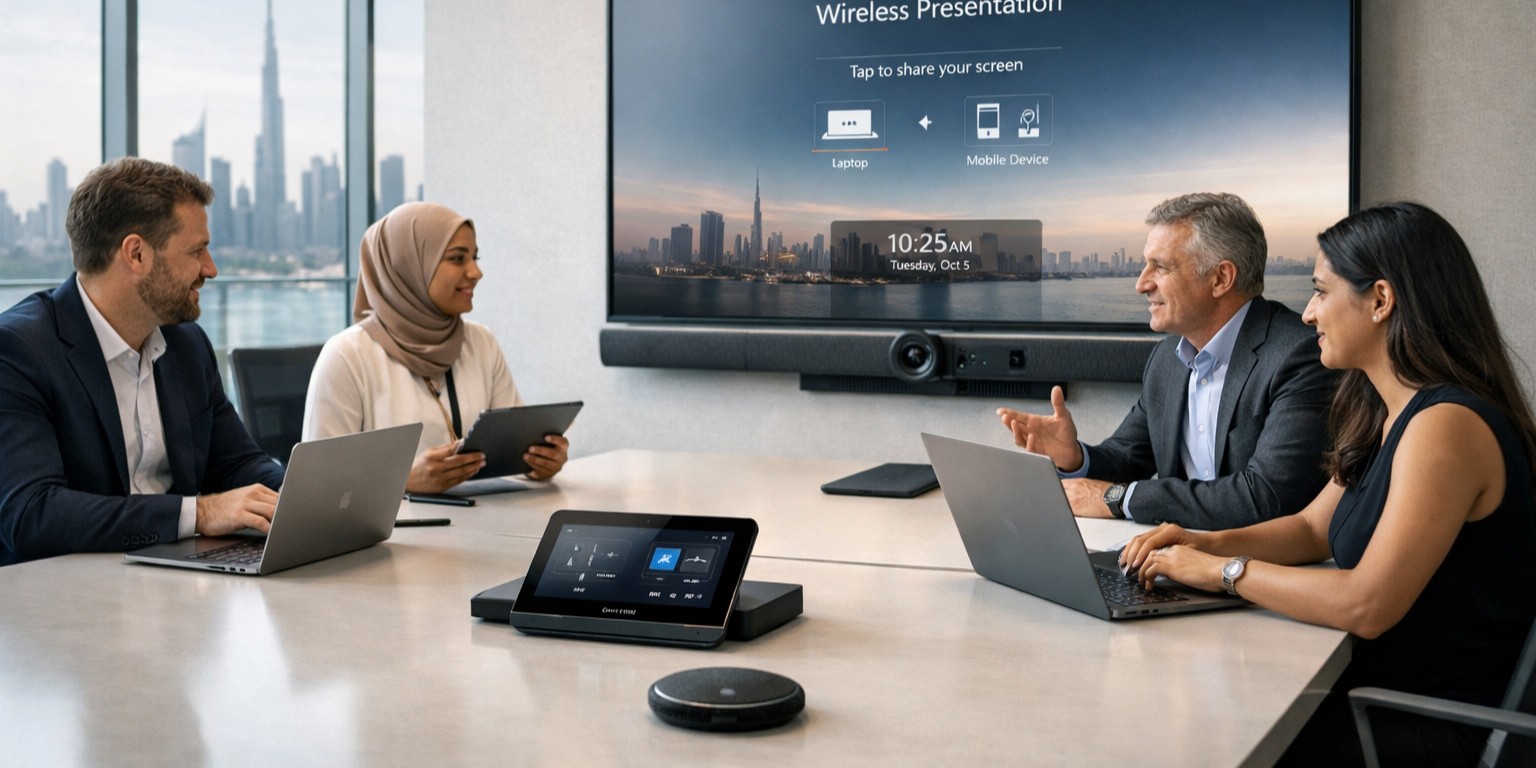
Traditional meeting rooms characterized by bulky projectors and chaotic cable arrangements are yesterday’s news compared to the modern wireless meeting rooms in the tech-driven Dubai. By outgrowing fixed infrastructures, these innovative meeting rooms offer freedom of movement and efficiency, encouraging the smooth flow of thoughts during global collaborations.
The UAE government has built an environment where technological innovation isn’t just invited but actively encouraged and implemented across all aspects of daily life. Thus, many modern office buildings and business centers in Dubai have been designed with wireless technology as a primary focus. Cable-free conference rooms are a distinguished feature of Dubai International Financial Centre (DIFC), Silicone Oasis, and many more, setting the benchmark for modern business communication.
The Evolution of Meeting Room Technology: From Wired Setups to Wireless Collaboration
The conference room has transformed from cluttered and outdated technological architecture to high-performing, and advanced wireless meeting spaces. Early meeting rooms struggled with challenges that compromised their only purpose-driving collaborations.
Challenges of Traditional Wired Meeting Rooms
Cable Clutter: The complex wiring chaos with interface elements like HDMI cables, adapters, and other physical connectors led to frustration and visual clutter.
Complex Connectivity: With the rise of multiple devices came the need for multiple adapters and dongles, increasing the time required for setup and causing presentation delays.
Restricted Mobility: The cable length and fixed displays restricted the free movement of presenters, making it difficult to keep the natural flow and switch presenters during the meeting.
Technical Failures: Unexpected wear and tear, loose connections, and signal degradation were common technical challenges that disrupted collaborations.
Key Technologies Powering Modern Wireless Meeting Rooms
Wireless meeting technology has consistently progressed through regular, utility-driven enhancements. The surging demand for smooth collaboration and greater flexibility has fuelled the shift from early meeting rooms. What once required bulky hardware and complicated setups has now turned into a streamlined, intuitive, and the most efficient solution. These wireless office solutions have a significant role in redefining workspace collaborations and connecting you better. Some of the advanced features that characterize modern wireless conferencing systems are,
Wi-Fi Technology: High-speed wireless networks that could handle high bandwidth operations like video conferencing.
Wireless Presentation Technology: Systems from top brands like Barco, Clevertouch, Crestron, etc., eliminate the need for physical connection and enable one-tap share.
Cloud-Based Collaboration Tools: Users can interact through document sharing, collaborative editing, and whiteboarding offered by various platforms.
Smart Display Solutions: Modern displays are computing devices that support touch control, annotation, and real-time content manipulation.
IoT Integration: Personal devices can be used to book meeting rooms and control its lighting, temperature, and more.
Business Benefits of Going Cable-Free with Wireless Meeting Rooms
Integrating wireless meeting room technology into your business delivers transformative benefits. Minimal cable clutter supports team mobility, simplifies installation, and eliminates potential hazards, improving productivity while ensuring the safety of the team members. Wireless networks cover extensive areas and offer the scalability needed for your business expansions. Although, significant initial investments can be discouraging, reduced long-term ownership costs and extended lifecycle are compelling reasons to choose wireless over wired technology.
Cost and Maintenance Advantages of Wireless Meeting Room Technology
Switching to cable-free office setups reduces long-term expenses and simplifies maintenance. Modern conference rooms in comparison to traditional settings require barely any wires, cutting down installation expenses and issues like cable wear and frequent replacements. Choosing wireless conference solutions means fewer hardware failures, less downtime, minimum safety hazards, and reduced IT overhead, resulting in significant financial savings.
Wired meeting rooms in comparison with wireless solutions incur large costs, owing to the need for hardware elements, including Ethernet cables and switch ports. They are wallet-draining even beyond the initial hardware costs, necessitating significant labor, cable management, and maintenance expenses. When scaling, the wired networks can be a real pain, demanding significant financial outlay and causing revenue shortfalls from disruptive installations. Wireless smart meeting rooms liberate you from these unnecessary financial burdens. With wireless solutions, scalability is no longer a concern, and meetings start with one tap on your personal or dedicated device. The productivity gains from cable-free and simplified setups such as better employee efficiency and space utilization, contribute to substantial ROI.
Security and Connectivity Considerations for Wireless Meeting Rooms
What happens in your meeting room needs to stay within its four walls and wireless conferencing systems are prone to cyber-attacks, raising concerns about data security. An unsecured system makes your meeting rooms vulnerable, allowing attackers to take complete control of the room through cameras and microphones. Thus, it is important to prioritize data security when choosing wireless meeting technology. Many wireless office solutions feature encryption protocols, multi-factor authentication, and role-based access controls that prevent unauthorized access and potential breaches.
Apart from security, connectivity issues are another concern that can cause headaches during wireless corporate meetings. To avoid frustrating and unproductive meetings, it is crucial to ensure proper connectivity. Organizations must invest in high-speed, low-latency networks that provide the bandwidth required for smooth video collaborations. Consider your specific requirements such as meeting room activities, system functions, and number of devices to implement suitable Wi-Fi, access points, and QoS (Quality of Service) configurations.
By following these best practices associated with security and connectivity, you can capitalize on the full potential of modern, cable-free conference rooms.
The Future of Wireless Meeting Rooms in Dubai
Dubai is all set to find new ways to innovate wireless meeting rooms. For example, low latency 5G networks will drive smoother collaborations while wireless displays will stream 8K visuals, making virtual meetings feel more real than ever. Dubai office technology with IoT devices will evolve to automate more functionalities based on occupancy and usage patterns, beyond the automation of temperature and lighting. AI-powered solutions will also take over meeting rooms, reducing manual efforts, and enhancing efficiency.
To keep pace with innovation in the business environment, you must adopt smart office solutions in Dubai, starting with wireless meeting solutions. Today, effective virtual collaboration is not just about connecting distances, it is also about a strategic advantage. So, make sure to invest in scalable systems and cloud-based communication platforms that not only live up to your present communication requirements but also adapt to changing market conditions.
Get in touch with GSIT today to discuss how we can transform your meeting rooms into intelligent, wireless collaboration hubs that drive productivity and innovation.


-
Address
GS IT (Global Surf IT Infrastructure)
SIT Tower, Dubai Silicon Oasis
P.O. Box 13653, Dubai, UAE -
Working Hours
Monday - Friday : 8.30am to 5.30pm
Remote Support : Available 24/7
-
Call Us
+971 4 578 6518
-
Mail Us
hello@gs-it.ae
Post a Comment