

13 Apr 2026

Wiper Malware in UAE: The ‘Delete Everything’ Cyber Threat that Businesses Must Prepare for in 2026
 by Admin
 0 Comment
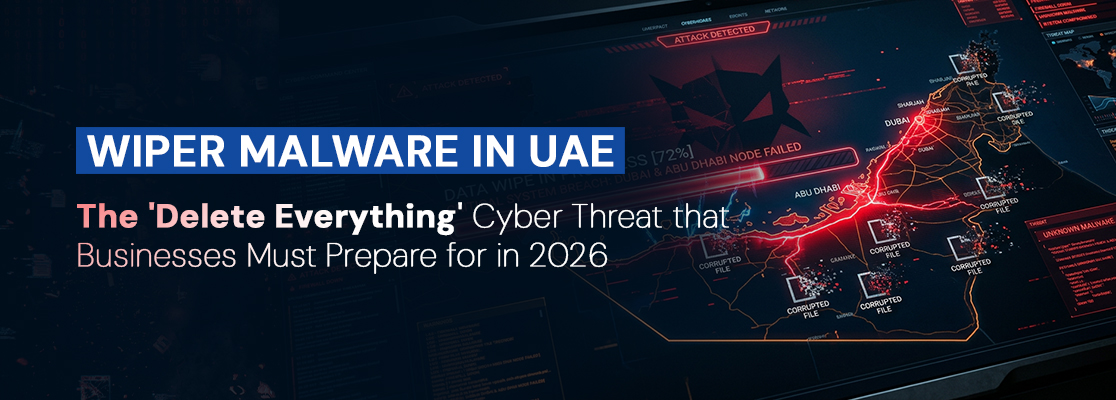
Table of Contents
- What Is Wiper Malware and Why It Is Far Worse Than Ransomware
- The Official Warning: UAE Cybersecurity Council, March 13, 2026
- The Attack That Proved This Threat Is Real: Stryker Corporation, March 11, 2026
- How a Wiper Attack Unfolds: The 5-Stage Attack Chain
- How GS IT Can Protect Your Business
There is a new kind of cyberattack spreading across the Middle East, and it does not ask for money. It does not negotiate. It does not leave a ransom note. It just wipes everything. Files, systems, databases, and operational records permanently. While most businesses in the UAE are still thinking about ransomware protection, a far more destructive threat has already arrived at the doorstep of the region's critical sectors.
Wiper malware is no longer a theoretical risk, but a destructive cyber threat capable of permanently erasing data and shutting down critical business operations, which is why security authorities have urged organizations to take this risk seriously. Across the GCC region, threat actors are increasingly targeting key sectors such as logistics, healthcare, finance, and real estate, and at GS IT, we work closely with businesses across Dubai and the wider GCC to strengthen security postures in response to this evolving threat landscape, where preparedness and resilience have become essential for business continuity.
This blog explains wiper malware, why it is more dangerous than ransomware, highlights the UAE Cybersecurity Council warning from March 2026, the Stryker Corporation attack, the five-stage attack chain, and how GS IT can help your business stay protected before the next wave hits.
What Is Wiper Malware and Why It Is Far Worse Than Ransomware
Most organizations understand ransomware. Files are encrypted, attackers demand payment, and in some cases paying the ransom may restore access to data. It is a criminal business model built around financial gain, where recovery, although costly and disruptive, is often still possible.
Wiper malware operates on a very different principle. Its purpose is not to make money but to cause damage. There is no demand, no negotiation, and no recovery key. Instead, data is permanently erased, critical system components are corrupted, and devices can become completely unusable.
A simple way to understand the difference is this: ransomware is like a robbery, where assets are taken but may be returned, while wiper malware is more like arson, where the damage is deliberate and irreversible.
Here's why wiper malware is particularly dangerous for businesses in the UAE right now:
It is geopolitically motivated
Unlike ransomware groups chasing money, wiper attacks are frequently deployed by nation-state actors and politically motivated collectives. Their goal is not profit, its disruption, humiliation, and operational paralysis. This means good cybersecurity optics do not deter them. They are looking for maximum damage.
It does not always need custom malware
One of the most unsettling developments in recent wiper attacks is that attackers have weaponized legitimate enterprise tools like Microsoft Intune's remote wipe function to execute destruction at scale. Catastrophic damage without a single line of custom malicious code.
Recovery is impossible without preparation
Because wipers destroy rather than encrypt, there is no decryption key to obtain. Without offline, tested, segmented backups you are starting from zero. Well-documented wiper malware examples include Shamoon (Saudi Aramco, 2012), NotPetya ($10B+ in global damage), HermeticWiper (Ukraine conflict), and newer AI-powered cyberattack variants now active across the GCC region.
The Official Warning: UAE Cybersecurity Council, March 13, 2026
On March 13, 2026, the UAE Cyber Security Council issued a formal, public warning regarding a significant spike in wiper malware activity across the region. The council stated clearly that these attacks are designed to delete or damage data, disrupt digital systems, and cause total operational paralysis, and that critical sectors are being specifically targeted.
The warning was not coincidental. It closely followed documented wiper attacks in Jordan and explicit threats made by the Iran-linked Handala hacker group against GCC nations in late February 2026. Iranian Advanced Persistent Threat (APT) groups have been conducting sustained espionage and disruptive operations against Gulf energy infrastructure since at least early 2025, with the pace and severity escalating sharply during periods of regional tension.
Dubai cybersecurity risks are no longer about financial fraud or phishing. The UAE is now operating within a threat environment that includes destructive tools capable of bringing entire organizations to a halt within hours. The gap between awareness and action is exactly where the damage happens, and many businesses in free zones, retail, real estate, and logistics remain dangerously underprepared.
The Attack That Proved This Threat Is Real: Stryker Corporation, March 11, 2026
On the morning of March 11, 2026, employees at Stryker offices around the world switched on their computers and found them wiped. Corporate systems across dozens of countries went dark simultaneously. The Handala hacker group claimed responsibility, asserting that offices in 79 countries had been forced offline after data was erased from more than 200,000 systems.
Here is what makes this case study so critical: the attackers did not use exotic custom malware. They exploited admin-level access to Microsoft Intune; the same enterprise device management platform businesses use every day to legitimately manage and update their device fleets. With admin credentials in hand, they executed a remote wipe command through a tool that was already trusted and deployed within the organization.
Within three hours, nearly 80,000 employee devices were remotely erased — laptops, workstations, and even personal phones enrolled in the corporate MDM system. Some departments lost up to 95% of their devices before anyone could react. There was no ransom note. No warning shot. By the time the IT teams understood what was happening, it was already done.
Handala had explicitly threatened GCC nations on February 28, 2026. The UAE is within the direct threat radius of this group, and every business operating in Dubai, Abu Dhabi, and across the wider GCC needs to treat this as a direct warning.
How a Wiper Attack Unfolds: The 5-Stage Attack Chain
Understanding how these attacks work is not just academic - it is how you identify where your defenses are weak. Every destructive malware attack follows a recognizable pattern.
- Initial Access: Entry through phishing emails targeting admin-privileged staff, unpatched vulnerabilities, compromised vendor credentials, or supply chain attack vectors against UAE businesses. This is where the door gets opened.
- Reconnaissance And Lateral Movement: Attackers move quietly, mapping the network, identifying high-value systems, and locating backup servers. This phase can last days or weeks. Without 24/7 monitoring via managed security services in Dubai, this goes completely undetected.
- Privilege Escalation: The attacker gains domain-level or cloud admin control by exploiting misconfigured accounts, unrotated credentials, or gaps in privileged access management. In environments using Microsoft Intune or Azure AD, this is where the attack becomes catastrophic in scale.
- Payload Deployment and Execution: Whether through a malicious script or an abused enterprise tool, destruction begins immediately. Modern wipers spread faster than detection. Without network segmentation, the damage crosses every connected system.
- Impact and Aftermath: Systems are down. Data is gone. Operational continuity is shattered. Without pre-planned incident response and tested backups, businesses face weeks or months of recovery if they recover at all. For SMEs and free zone businesses across the UAE, the impact could mean permanent closure.
How GS IT Can Protect Your Business
Wiper attacks are preventable. They rely on gaps in defenses that disciplined, well-structured IT security can close. At GS IT, managed security services and IT AMC services in Dubai are designed to address destructive, fast-moving cyber threats through layered protection, continuous monitoring, and rapid response capabilities.
Advanced Backup & Disaster Recovery Solutions
Modern businesses cannot rely on basic backups alone. A resilient backup and disaster recovery strategy ensures that critical data and systems can be restored quickly even after a destructive cyber incident.
GS IT provides structured backup and recovery solutions that support business continuity by protecting data integrity and availability. These services are designed to restore operations after system failures, cyberattacks, or data loss events, ensuring organizations can continue operating with minimal disruption.
Endpoint Detection & Response (EDR)
Endpoints such as laptops, servers, and mobile devices are often the first targets in modern cyberattacks. Endpoint Detection and Response (EDR) solutions continuously monitor these devices to identify suspicious activity, isolate threats, and prevent attacks from spreading across the network.
GS IT delivers advanced endpoint security solutions that use real-time monitoring, threat intelligence, and automated response capabilities to detect and contain sophisticated cyber threats before they cause damage.
24/7 SOC Monitoring
Cyber threats do not operate on a schedule. Continuous monitoring is essential to detect and respond to attacks before they escalate into major incidents. A Security Operations Centre (SOC) provides centralized visibility into network activity and enables rapid response to emerging threats.
GS IT IT AMC services offers round-the-clock SOC monitoring that uses advanced analytics and threat intelligence to detect suspicious behavior, investigate incidents, and implement corrective actions to minimize risk and maintain security resilience.
Vulnerability Assessment & Patch Management
Most cyberattacks succeed because systems contain known vulnerabilities that have not been fixed. Regular vulnerability assessments and timely patching reduce the attack surface and prevent attackers from exploiting security weaknesses.
GS IT provides continuous vulnerability management services that identify security gaps across networks, applications, and devices, and apply automated patches to address risks before they can be exploited by attackers.
Protect your business before a crisis strikes. Consult GS IT’s security specialists to strengthen defenses and ensure operational resilience against destructive cyber threats.


-
Address
GS IT (Global Surf IT Infrastructure)
SIT Tower, Dubai Silicon Oasis
P.O. Box 13653, Dubai, UAE -
Working Hours
Monday - Friday : 8.30am to 5.30pm
Remote Support : Available 24/7
-
Call Us
+971 4 578 6518
-
Mail Us
hello@gs-it.ae
Post a Comment